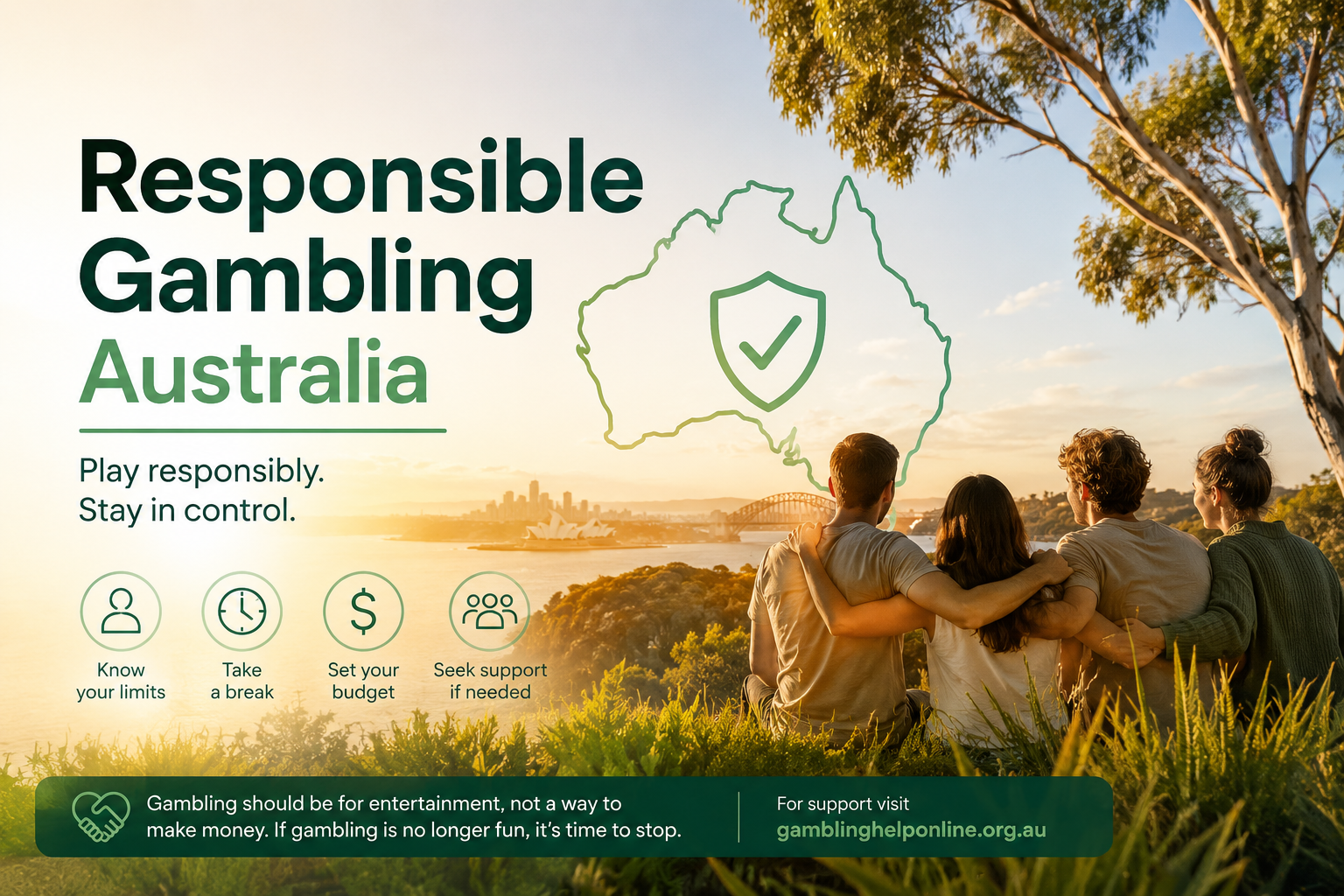
Responsible Gambling at Online Casinos in Australia
Responsible Gambling at Australian Online Casinos
Online gambling has become accessible and convenient for Australian players, but this accessibility comes with responsibility. Whether you're playing at a licensed operator or exploring international platforms, understanding how to gamble safely protects your finances, time, and wellbeing. This guide covers the practical tools, warning signs, and strategies that help you maintain control over your gambling activity.
Understanding Your Risk Profile
Before you set limits or choose a casino, it's worth being honest about your relationship with gambling. Not all players face the same risks. Someone who plays occasionally with money they can afford to lose faces different challenges than someone with a history of compulsive behaviour or financial stress.
Ask yourself these questions:
Do you gamble to relax, or to escape difficult emotions?
Have you ever spent more than you planned?
Do friends or family express concern about your gambling?
Are you gambling with borrowed money or funds meant for essentials?
Do you feel an urge to gamble more frequently or with larger amounts?
Answering honestly helps you decide which safeguards matter most. If you recognise patterns of concern, stronger tools and external support become essential rather than optional.
Deposit Limits: Your First Line of Defence
Deposit limits are the most straightforward tool for controlling spending. They cap how much you can deposit into your casino account within a set timeframe—usually daily, weekly, or monthly.
How to use them effectively:
Set limits before you play. Decide your budget while thinking clearly, not during a gaming session.
Match limits to disposable income. Your deposit limit should represent money you genuinely don't need for rent, bills, food, or debt repayment.
Use multiple timeframes. Some casinos allow you to set daily and weekly limits simultaneously. Shorter timeframes provide tighter control.
Request lower limits from customer support. If you can't reduce your limit through the account settings, contact support and ask them to lower it on your behalf. This adds friction, which is intentional.
Most Australian-licensed operators and many international platforms offer deposit limits as standard. Check whether your chosen casino allows you to set limits lower than their minimum, and verify that limits apply across all payment methods.
Loss Limits and Spending Caps
Some casinos distinguish between deposit limits (money in) and loss limits (net losses). A loss limit prevents your account balance from dropping below a certain point in a session or over time.
This is useful because:
A player might deposit $100, win $50, then chase losses by depositing again. A loss limit catches this pattern.
Loss limits focus on your actual financial impact, not just deposits.
They work alongside deposit limits for layered protection.
If your casino offers loss limits, enable them. If not, track your net spending manually by recording deposits and withdrawals, or use a spreadsheet to monitor your account balance over time.
Session Time Limits and Reality Checks
Time disappears quickly when you're focused on games. Session limits automatically log you out after a set period, forcing a break.
Why time limits matter:
Extended sessions increase the likelihood of chasing losses.
Fatigue impairs judgment about spending and risk.
A forced break creates space to reassess whether you want to continue.
Set session limits between 30 minutes and 2 hours, depending on your habits. Some casinos offer "reality check" features that remind you how long you've been playing and how much you've spent, without logging you out. Use both if available.
Self-Exclusion: When You Need to Step Back
Self-exclusion is a formal agreement between you and the casino to suspend your account for a set period—typically 6 months to several years. During exclusion, you cannot log in, deposit, or play.
Key points about self-exclusion:
It's legally binding. The casino must enforce it. Attempting to open new accounts during exclusion is a breach.
It's not permanent by default. You specify the duration. After it ends, you can request account reactivation, though some casinos may require you to wait or complete additional steps.
Request it in writing. Use email or the casino's official self-exclusion form to create a documented record.
It applies only to that casino. Self-excluding from one operator doesn't prevent you from playing at others. For broader protection, use multi-operator schemes like the Australian self-exclusion register if available in your jurisdiction.
Self-exclusion is most effective when you're experiencing serious control issues. It removes the temptation of easy access and gives you a defined period to seek support or change your habits.
Recognising Warning Signs
Responsible gambling isn't just about tools—it's about noticing when your behaviour is shifting. Early recognition allows you to intervene before problems deepen.
Financial warning signs:
You're depositing more frequently or in larger amounts than planned.
You've started using credit cards or loans to fund gambling.
You're neglecting bills, savings, or debt repayment to gamble.
You're experiencing financial stress you attribute directly to gambling losses.
Behavioural warning signs:
You think about gambling when you're not playing.
You've tried to cut back or quit but couldn't stick to it.
You gamble to escape stress, anxiety, or low mood rather than for entertainment.
You're secretive about your gambling or lie about how much you're spending.
You've experienced relationship tension because of your gambling.
You feel a need to gamble with increasing amounts to get the same level of excitement.
If you recognise several of these signs, it's time to take action—whether that's tightening your limits, using self-exclusion, or seeking professional support.
Support Resources in Australia
If you're struggling with gambling, professional support is available and confidential.
Gambling Help Online offers free counselling, self-assessment tools, and resources. You can chat with a counsellor, call, or access online resources without cost.
Lifeline provides crisis support if you're experiencing severe distress related to gambling losses or compulsive behaviour.
Gamblers Anonymous runs peer support meetings across Australia for people seeking recovery from gambling addiction.
Many workplaces and health insurance providers also offer Employee Assistance Programs (EAP) that include confidential counselling for gambling issues. Check whether this is available to you.
Seeking help early is more effective than waiting until problems escalate. There's no shame in asking—gambling harm affects people across all income levels and backgrounds.
Choosing a Casino with Strong Responsible Gambling Features
Not all casinos offer the same level of protection. When evaluating a platform, check for:
Deposit, loss, and time limits that are easy to set and adjust.
Reality check reminders during play.
Self-exclusion options with clear processes and enforcement.
Account cooling-off periods that let you pause your account for days or weeks without full exclusion.
Transparent terms about how limits work and what happens when they're triggered.
Links to support services displayed prominently, not buried in fine print.
Licensed casinos in Australia are required to offer certain protections by law. International operators vary widely—some take responsible gambling seriously, others less so. Research the operator's policies before you sign up.
Practical Strategies for Safe Play
Treat gambling as entertainment with a cost. Set a budget like you would for cinema tickets or dining out. Once it's spent, stop.
Never chase losses. Losing is part of gambling. Depositing more to recover losses almost always results in deeper losses. Accept the loss and move on.
Keep gambling and other finances separate. Use a dedicated account or card for gambling, funded only with money you've explicitly set aside. This makes overspending harder and more visible.
Set a win limit too. Decide in advance how much you'd like to win before you stop playing. When you hit it, withdraw and close the session.
Avoid gambling when emotional. Stress, loneliness, boredom, or low mood often drive problematic gambling. If you're gambling to feel better, pause and find another activity.
Tell someone you trust. Sharing your goals with a friend or family member creates accountability and gives you someone to talk to if you're struggling.
Frequently Asked Questions
Can I lower my deposit limit immediately, or is there a waiting period?
Most casinos allow you to lower your limit immediately through account settings. However, increasing a limit usually involves a waiting period (often 7 days) as a safeguard. If you need urgent help reducing access, contact customer support and request they lower your limit on your behalf—this typically takes effect within hours.
What happens if I reach my deposit limit mid-session?
You won't be able to deposit more money. Your existing balance remains playable. This is intentional—it stops you from adding funds impulsively during a session. If you need to deposit again, you'll have to wait until the limit resets (usually the next day or week, depending on your settings).
If I self-exclude, can I still withdraw my remaining balance?
Yes. Self-exclusion prevents new deposits and play, but you can request a withdrawal of your account balance. Contact customer support to arrange this. The funds should be returned to your original payment method.
Does self-exclusion from one casino protect me from others?
No. Each self-exclusion is specific to that operator. If you want broader protection across multiple casinos, check whether your state or territory has a multi-operator self-exclusion register or scheme. Some Australian jurisdictions offer this; others don't.
What if I think I have a gambling problem but I'm not ready to self-exclude?
Self-exclusion isn't the only option. Start by setting stricter limits, enabling session time limits, and reaching out to a counsellor through Gambling Help Online or your GP. Many people benefit from talking to someone before their situation becomes critical. Counselling is free and confidential.
Can casinos override my self-exclusion if I ask them to?
They shouldn't. Self-exclusion is designed to protect you by removing your ability to override the decision in a moment of weakness. Reputable casinos will refuse to reactivate your account before the agreed exclusion period ends, even if you ask. This is a feature, not a flaw.
Are international casinos required to offer responsible gambling tools?
It depends on their licensing jurisdiction. Licensed operators in regulated markets (like Malta or the UK) are required by law to offer tools. Unlicensed operators may offer them voluntarily, or not at all. This is one reason to research an operator's background before playing.
Final Thoughts
Responsible gambling is about making informed choices and maintaining control. The tools exist—deposit limits, time limits, self-exclusion, and support services—but they only work if you use them. Be honest about your habits, set limits before you play, and don't hesitate to reach out for support if you notice warning signs. Gambling should be entertainment, not a source of financial or emotional harm.